Industry Sasha Verre9 min read
Inside the UK pole studio scene in 2026 — the numbers, the rooms, the people
Two hundred and ninety-three studios. Twelve thousand polers a month. We mapped the UK pole scene — and noticed a few things.
Sasha Verre9 min read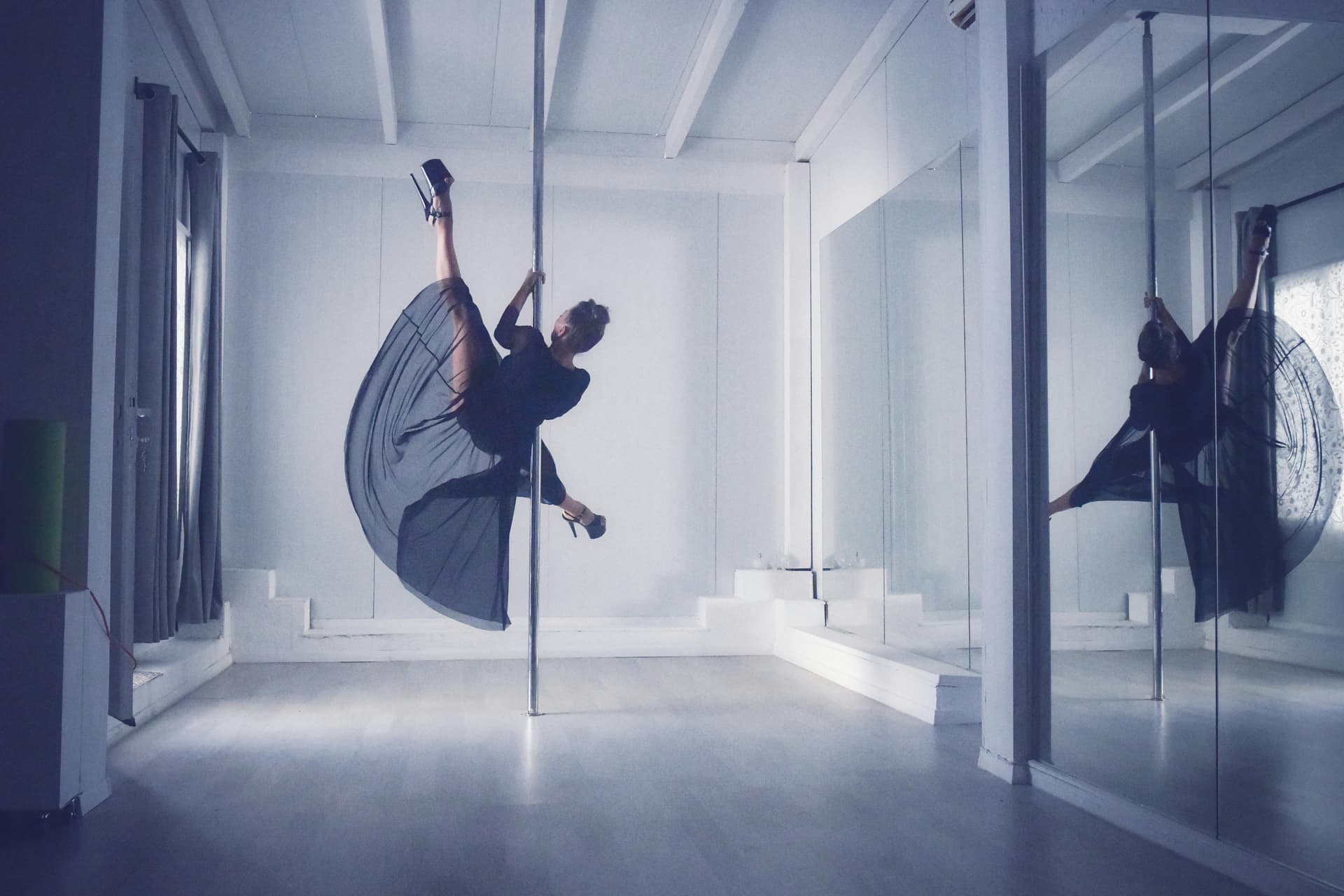
Pole has grown up in the UK over the last five years. The scene is no longer a few studios in Soho and a handful of dedicated competitors — it's hundreds of small businesses, in every city, teaching a mix that wouldn't have been imaginable a decade ago. We've spent the last six months mapping every active pole studio in the UK for the Pole Club directory. The numbers are bigger than we expected. The shifts are clearer than we expected. And the scene, surprisingly, is converging on a remarkably consistent culture from Brighton to Edinburgh.
By the numbers
293 active pole studios in the UK, by our count. London leads with 89; Manchester has 24; Birmingham 17. The fastest-growing markets are Brighton, Bristol, and Edinburgh — each up by at least three studios on this time last year. Cardiff has doubled in three years. Belfast has its first dedicated heels-only studio.
Roughly 12,000 unique polers attend a UK class at least monthly. Booking density is highest on Tuesday and Wednesday evenings (6–9pm) and Saturday mornings (10am–12pm). Sunday afternoons, which used to be the second-busiest slot in 2019, are now the quietest — a side-effect of the shift toward shorter, more frequent classes during the week rather than long weekend workshops.
“The vibe shift: every UK studio now offers a Level 1 with no requirement to invert in your first 12 weeks. That wasn't true in 2019.”
Who's poling?
60% of polers in the UK are between 25 and 39. The over-40 cohort is the fastest-growing segment year-on-year, and the men's-only Tuesday-night class at Lumen in Clapham is consistently the studio's most-booked class. Mixed-gender classes are now standard everywhere; women-only timetable slots still exist but are typically labelled by hour rather than enforced by signup.
Pole is becoming a habit, not a phase. The median UK poler now stays with their studio for fourteen months, up from seven in 2021. The retention shift is doing more for studio economics than any marketing campaign — it's why so many studios that closed in 2020–21 are profitable again now.
What's actually being taught
Three broad streams have emerged across the UK. The first is traditional pole — Russian/Eastern-European-inspired technique, lots of climbs, lots of holds, lots of inversions later in the syllabus. The second is heels-and-floorwork — closer to choreography than gymnastics, with floorwork built around the pole rather than reliant on it. The third, growing fastest, is exotic pole — a slower, more body-focused style that bridges the other two and produces the most consistent social-media output.
What's striking is how consistent the curricula are between studios. A Level-2 inversion class at Pillar in Shoreditch teaches almost exactly the same moves as Level-2 at Arc in Kings Cross or Skyline in Brighton. The same goes for heels. This is a quiet professionalisation — most studios now pull instructors who themselves trained at other UK studios in the last five years, and the knowledge transfer is producing a remarkably uniform UK syllabus.
What's still missing
There is no UK-wide qualification body for pole instructors. The PFA in the US and the IPSF in international competition both certify, but at studio level, in the UK, training is informal and reputation-based. This works — but it makes it hard for a new poler to evaluate a studio they've never visited.
There's also a gap in regional access. If you live in a small city or a rural area, you might be a forty-five-minute drive from the nearest studio. The home-pole market has grown in response — the Lupit and X-Pole brands sold roughly 11,000 home poles into the UK last year — but it's not a substitute for an instructor in a room.
Where it goes next
Three predictions for 2027. First, more studios will offer hybrid memberships: in-studio classes plus a curated online library. Second, heels and exotic will take a larger share of the timetable as inversion-heavy traditional pole stops being the default beginner journey. Third, the UK competitive scene — currently scattered between half a dozen organisations — will consolidate. Whether that's good for the sport depends on who consolidates with whom.
What's certain is that pole in the UK is no longer a niche. It's a quiet, capable, growing scene with serious instructors, real businesses, and an audience that's getting younger, older, more male, and more committed at the same time.
Keep reading
See all posts →
Classes & Costs
Pole Class Etiquette: The Unwritten Rules Every Studio Wishes You Knew
The unwritten rules of pole class etiquette — wiping the pole down, sharing fairly, phones, hygiene and why you should never teach the person next to you. Fit in from class one.
Classes & Costs
How to Practise Pole on a Budget
Practical ways to do pole dancing on a budget — blocks over drop-ins, taster deals, minimal kit, off-pole practice at home and buying second-hand without cutting safety corners.

Classes & Costs
The Real Cost of Starting Pole: A First-Year Budget Breakdown
What pole really costs in year one — classes, kit, grip aids and an optional home pole — broken down into casual, committed and keen budgets so you know what you're signing up for.